
1st March 2026
Object of the Month: Water Flask – Baadla
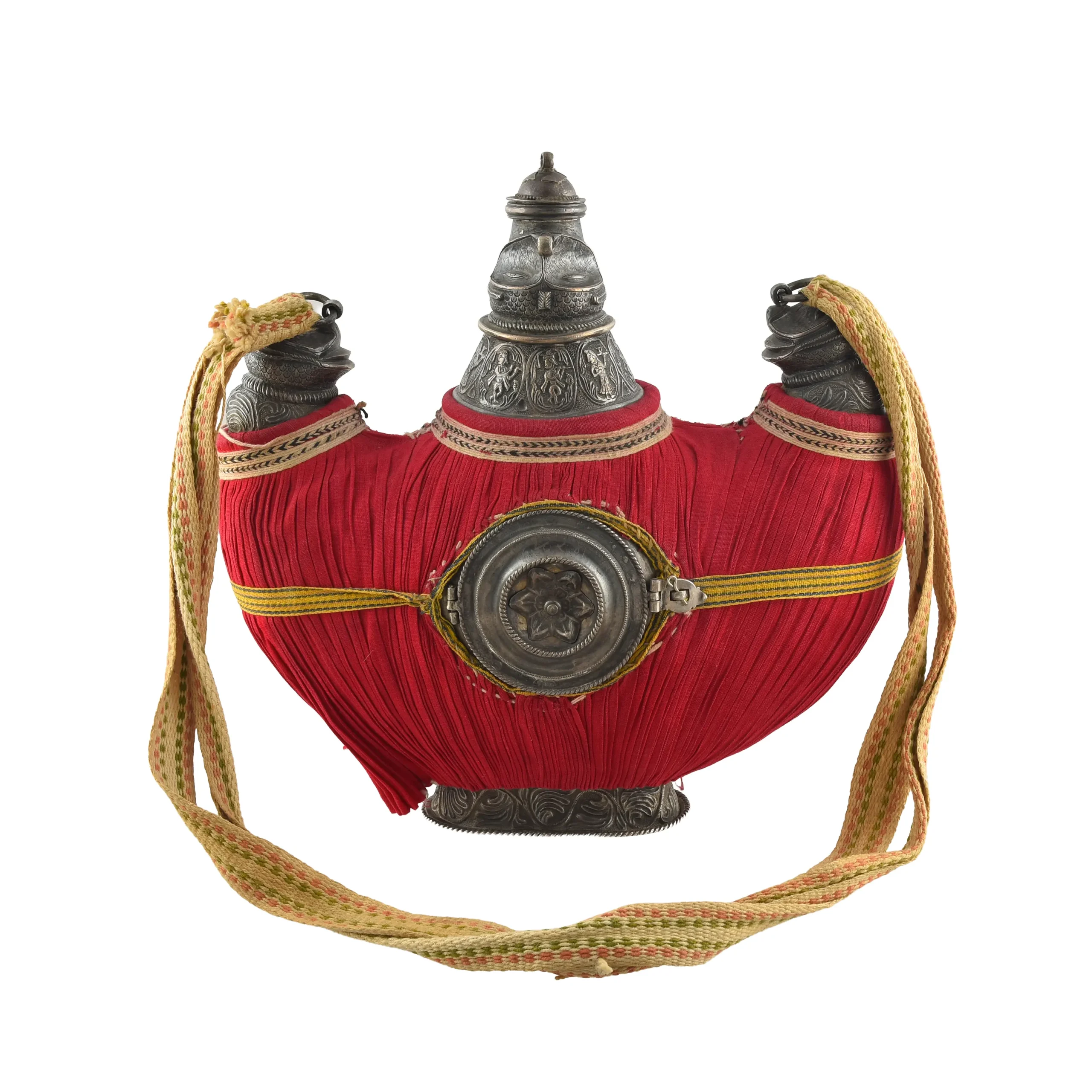
The baadla (also spelled badla or baadlo) is a traditional water flask widely used in the arid regions of western Rajasthan, where the storage and cooling of water have long been essential to daily life. Typically crafted in metal most commonly brass, copper, or occasionally silver the baadla is distinguished by its rounded or globular body, a narrow neck, and a small opening designed to minimise spillage and evaporation.
Its form is both practical and efficient: the curved body allows for ease of carrying, often slung over the shoulder or balanced on the hip, while the narrow mouth helps to keep the water cool and protected from dust.
In regions such as Jodhpur and Jaisalmer, the baadla served as an indispensable companion during long journeys across desert terrain, used by travellers, pastoral communities, and women fetching water from distant sources. In more affluent contexts, these vessels were often elaborately decorated with engraved or repoussé ornamentation, reflecting both local craftsmanship and social standing.
Beyond its utilitarian function, the baadla holds cultural significance, frequently appearing in domestic rituals and, at times, forming part of dowries or ceremonial exchanges. It symbolises sustenance and continuity of life within a demanding environment. The addition of a cloth covering often in vibrant hues provided insulation against heat while also enhancing its visual presence. As an object, the baadla embodies a nuanced understanding of climate, material, and tradition, illustrating how communities adapted resourcefully to the challenges of their surroundings.